2025 marked a profound milestone – the 30th anniversary of the BACnet protocol’s publication as an ASHRAE/ANSI standard. Three decades ago, an industry defined by proprietary, fragmented communications protocols took a dramatic leap toward openness and interoperability. Today, BACnet is more than a standard; it is the global operating language of intelligent buildings, a platform driving unprecedented energy efficiency, occupant wellness, and technological innovation. This anniversary is a moment to look back at our improbable origins, celebrate our current role as the global standard, and, most importantly, commit to the next era of smart, sustainable infrastructure that the protocol continues to enable.
BACnet (Building Automation and Control Network) was just a vision in June 1987 when the ASHRAE Standard Project Committee 135P was formed. Initiated and chaired by the late H. Michael Newman, the “Father of BACnet,” this committee was tasked with the seemingly impossible: creating an open, non-proprietary communication protocol that could allow devices from multiple manufacturers and systems (HVAC, lighting, fire safety, security, and more) to communicate seamlessly.
It was a process fraught with technical challenges and fierce commercial resistance. It took eight years of tireless work, complex negotiations, and a deeply committed consensus process to bring the standard, ANSI/ASHRAE Standard 135, to publication in 1995. This moment was revolutionary. BACnet did not simply offer another communication method; it defined a common object model, a universal way to describe an input, an output, a schedule, or an alarm, that systems could understand, regardless of who made them. This object-oriented approach was the foundation upon which true, cost-effective interoperability was built.
The industry impact was broad and deep. Manufacturers, no longer constrained to building a full, proprietary ecosystem, could specialize, leading to a surge of innovation and a dramatic reduction in system lifecycle costs for building owners. The following is a detailed timeline of BACnet development:

1986
ASHRAE Technical Committee 1.4 approved the development of a protocol guideline.
1987
Guidelines submitted to ASHRAE Standard Committee.
The first Standard Project Committee met in Nashville and formed the first three working groups. Michael Newman, Founder of BACnet, served as the first Chair.
1990
The BACnet name was coined and approved by ASHRAE.
1991
First public review issued.
Test tool development and informal manufacturing testing began.
1993
Facilitated by Steven Bushby, the NIST BACnet Interoperability Testing Consortium was formed with 22 manufacturers.
Second public review issued.
1994
Third public review issued.
1995
BACnet is published as an ASHRAE Standard after multiple public reviews.
Virtual Test Shell (VTS) released.
BACnet Vendor ID #1 issued.
BACnet became an ANSI Standard.
1996
BACnet demonstrated its interoperability capabilities at the AHR Expo, with multiple manufacturers participating.
First Standing Standard Project Committee 135 (SSPC-135) meeting.
1998
Second Virtual Test Shell (VTS) released.
BACnet Interest Group Europe (BIG-EU) formed.
1999
BACnet Interest Group North America (BIG-NA) formed.
BACnet/IP data link added.
2000
BACnet Manufacturers Association (BMA) formed.
BACnet Testing Laboratories (BTL) Working Group formed.
Trend log, Averaging, and Multi-state Value objects added.
2001
Third Virtual Test Shell released.
Initial BACnet Interoperability Building Blocks (BIBBs) and Device Profiles added.
Life Safety objects added.
Protocol Implementation Conformance Statement (PICS) added.
2002
First BTL Listing issued.
2003
EN ISO 16484-5 2003 published.
Trend Log objects added.
2004
First BTL PlugFest Interoperability Workshop.
Energy metering objects added.
2005
First BACnet Workstation device profile added.
Structured View objects added.
2006
BIG-NA and BMA merged to form BACnet International.
BACnet began supporting web services (B/WS).
2007
Load Control and Access Door objects added.
2008
Event Log and Trend Log Multiple objects added.
2009
Access Control objects and functionality added.
Workstation BIBBS and Profiles added.
Network Address Translation (NAT) support to BACnet/IP added.
2010
Global Group objects added.
UTF-8 replaces ASCII as the default character set.
Primitive Value objects added.
XML Data Format added.
2011
Alarm and events updates added.
Notification Forwarder and Alert Enrollment objects added.
B-OWS, B-AWS, B-OD Device Profiles added.
2012
Lighting objects and services added.
2013
Subordinate Proxy BACnet Interoperability Building Blocks (BIBBs) added.
2014
Extended MS/TP frames added.
Binary Lighting Output object added.
B-RTR, B-GW, B-BBMD, B-GENERAL device profiles added.
Timer object added.
Network Port object added.
Value Source properties and processes added.
2016
BACnet/IPv6 data link added.
Elevator, Lift and Escalator objects added.
Access Control and Life Safety BIBBs added.
All Domain B-XAWS Profile added.
BACnet/WS with RESTful services added.
Semantic Tags to all objects added.
2017
First BTL Certificate issued.
The BACnet Institute (TBI) was launched.
1,000th Vendor ID issued.
2018
Staging object added.
Lighting BIBBs and Profiles added.
Audit Reporting functionality added.
1,000th BTL Listing issued.
2019
BACnet Secure Connect added.
BACnet/SC Acceleration Program #1 launched.
Elevator BIBBs and Profiles added.
Time Series Data Exchange file format added.
2020
TBI received IACET Accreditation and began issuing free CEUs.
2021
BACnet/SC Cipher Suite support added.
2022
Free BACnet/SC reference implementation made available.
Color Functionality and Color Temperature objects added.
Configuration of BACnet/SC to the Network Port object added.
B/SC Certificate replacement procedures issued.
Interoperable communications configuration added.
2023
Cybersecurity Acceleration Program launched.
2024
Certificate Authority Requirements Interchange File Format released.
BACCARI Certificate Authority Reference implementation Beta released.
Device Address Proxy support added.
1500th BACnet Vendor ID assigned.
2025
Authentication and Authorization were developed for BACnet Secure Connect.
BACnet Energy Services Interface (BACnet ESI) added.
BACnet celebrates its 30th Anniversary as an ASHRAE Standard.
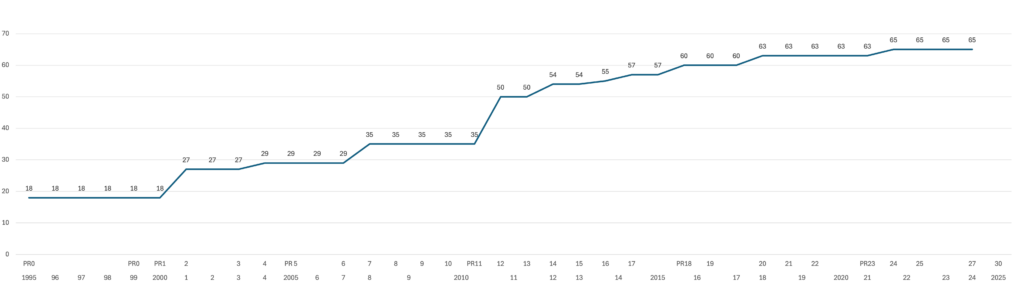
Addenda Total
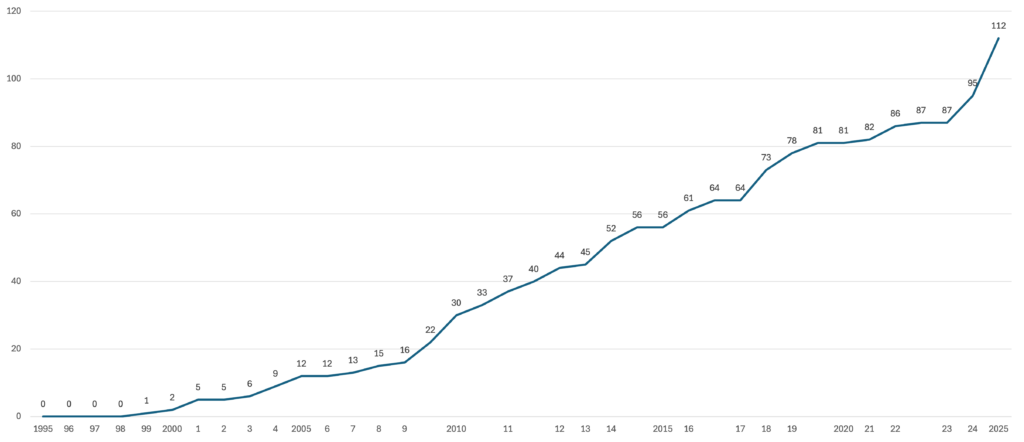
Addenda by Year and Protocol Revision
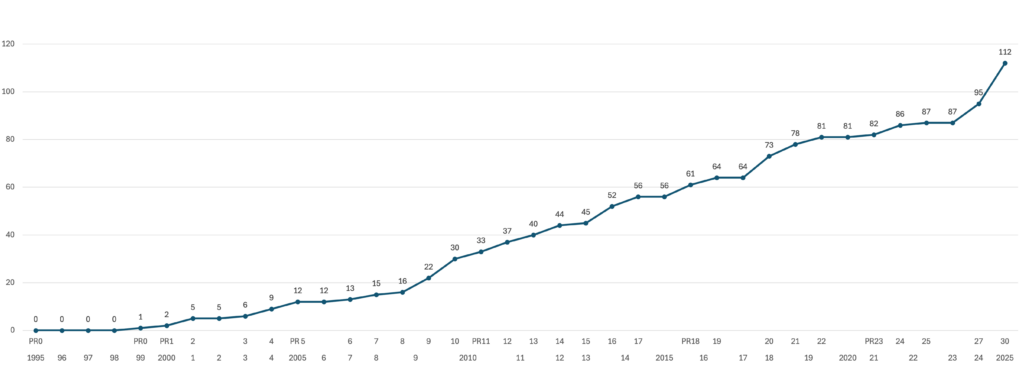
Objects by Addenda and Protocol Revisions
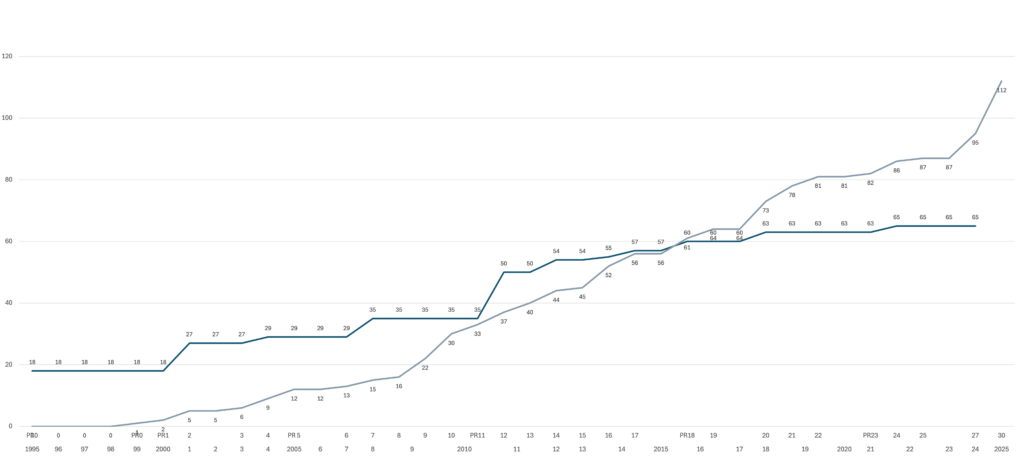
Number of Objects by Protocol Revisions and Date